WATER HABITAT CARBON

At JMT Wilderness Conservancy, our mission is to restore the watersheds, wilderness, and wildlife in the high Sierra Nevada, following the John Muir Trail. Our work is guided by three essential pillars: Water, Habitat, and Carbon.

Water

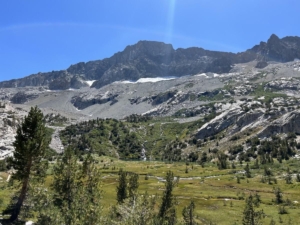
Water sustainability in the West is increasingly under pressure. Montane meadows were once natural sponges that retained and slowly released water from the high Sierra down major rivers on both the east and west sides of the range. After two centuries of human impacts, these meadow ecosystems have substantially lost their historic acreages and are losing their ability to store water. The Low Tech Process-Based Restoration (LTPBR) methods our team utilizes mimic natural processes to restore sensitive meadow ecosystems to revive these landscapes. Water infiltration is improved; original meadow footprints are reclaimed; and water resources are better secured for the surrounding communities that rely on them.

“What the JMT Wilderness Conservancy is doing to restore the meadow ecosystems of the central Sierra Nevada is precisely what we need to go beyond theory and put multiple-benefit strategies into action on the ground.

The Conservancy is doing the hands-on implementation work necessary to make our water supply more resilient while providing multiple benefits for people, wildlife, and ecosystems.”

-Felicia Marcus

Professor at Stanford University, William C. Landreth Fellow: Water in the West Program

Habitat

Healthy meadows and riparian habitats are the backbone of biodiversity in the Sierra Nevada. These ecosystems support a wide range of biological, botanical, amphibian, and insect species found nowhere else on Earth. By restoring degraded riparian corridors and meadow ecosystems, we are rebuilding critical habitats that sustain wildlife, strengthen ecosystems, and support California’s biodiversity. The Sierra Nevada is a recognized biodiversity hotspot, which is why protecting it is more important than ever.

Carbon

Healthy meadows can capture up to 10 times more carbon than any other types of vegetation. By restoring meadow ecosystems, we’re not only improving water and habitat, but also harnessing one of nature’s most powerful tools to combat climate change. These landscapes act as vital carbon sinks that absorb and store more carbon dioxide from the atmosphere than they release, helping to regulate the Earth’s temperature and mitigate climate change.

“Climate change threats in the Sierra Nevada include rapid amplification of fire intensity and frequency, driven by a feedback loop of higher temperatures, negative water balance, and loss of water-retaining ecosystems. The cycle can be short-stopped locally by the restoration of montane meadow wetlands, exactly the kind of work that JMT Wild has become adept at.

There is an important co-benefit in the enhanced carbon storage capacity of high mountain meadows following restoration, a benefit that counts towards California’s net C budget as the state moves to net-zero CO2 emissions by 2045.

Policy makers, including those in California, are increasingly looking to landscape-scale terrestrial strategies to manage climate impacts. JMT Wild’s efforts now work to scale to that end.”

-Dr. Rob Dunbar,

Professor at Stanford University, Doerr School of Sustainability

Water, Habitat, and Carbon are interconnected, and so is our work. Restoring one strengthens them all, creating a more resilient Sierra Nevada.